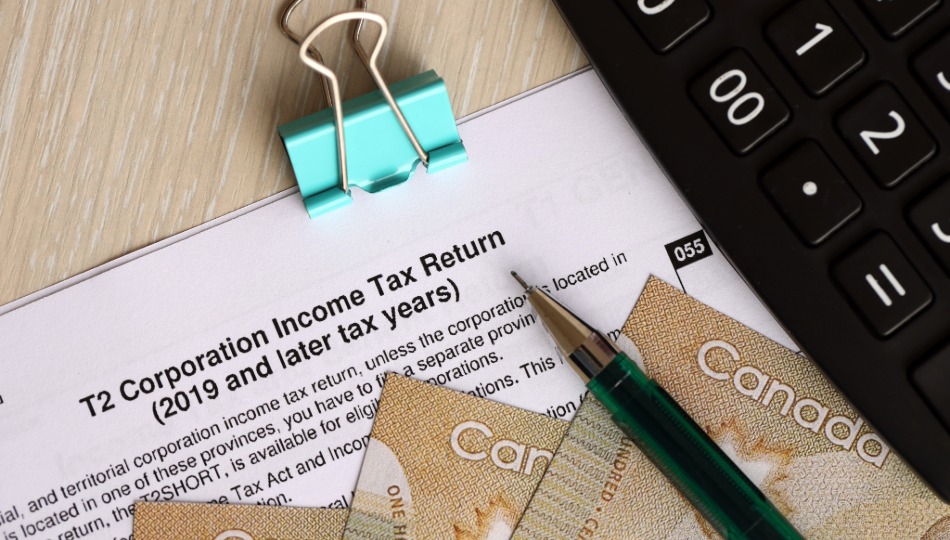
If you’re an incorporated business in Canada, you’re required to file a T2 corporate tax return every year. Whether you made a profit, lost money or had no activity at all, the filing requirement applies.
Done properly, it protects you from penalties, reduces audit exposure, preserves small business deduction eligibility, and aligns your corporate structure with your long-term wealth plan.
Done poorly, it quietly creates future tax problems.
This guide explains what filing a T2 involves and what sophisticated business owners should be paying attention to beyond compliance.
This guide explains:
- What Is A T2 Corporate Income Tax Return and Why It Matters
- Who Must File A T2?
- Key filing and payment deadlines
- Penalties for late filing
- How to prepare and file correctly
- Whether you need a CPA
- Why corporate tax filing in Ottawa benefits from local expertise
What is a T2 Corporate Income Tax Return?
A T2 corporate income tax return reports your corporation’s financial results for its fiscal year and calculates both federal and provincial corporate income tax.
It includes:
- Revenue and operating expenses
- Capital asset additions and depreciation (CCA)
- Balance sheet information
- Shareholder information
- Dividends paid
- Reconciliation from accounting income to taxable income
This is separate from personal tax reporting. Individuals file a T1 return. Corporations file a T2. The obligations are distinct and must be managed accordingly.
Every incorporated business, including professional corporations, holding companies, real estate corporations, and inactive corporations, must file annually. Incorporation carries permanent compliance obligations, regardless of profitability.
Need a CPA to prepare or review your corporation’s T2 return?
Boyer & Boyer, CPA provides corporate tax filing and planning services for incorporated businesses in Ottawa.
Do All Corporations Have to File a T2? Yes.
One of the most common questions we hear is whether a corporation must file if it earned no income.
The answer is yes.
The CRA requires almost every resident corporation to file a T2 corporate income tax return, even if:
- The corporation had no revenue
- The corporation operated at a loss
- The corporation was inactive
- No tax is owing
Failing to do so can trigger penalties, compliance issues, and administrative complications if the corporation later applies for financing, restructures, or dissolves.
For incorporated businesses operating in Ottawa and throughout Ontario, this requirement is absolute.
Filing Deadline vs. Payment Deadline: A Costly Confusion
Corporate tax compliance involves two separate deadlines: one for filing the T2 return and one for paying corporate income tax.
Filing Deadline: Your T2 corporate income tax return must be filed no later than six months after your fiscal year end.
Payment Deadline: Corporate tax is generally due earlier
- Most Canadian-controlled private corporations eligible for the small business deduction must pay within three months of year end.
- Other corporations must pay within two months of year end.
Confusing these two dates is a frequent and costly mistake.
Corporate Tax Filing and Payment Deadlines (Quick Reference)
| Requirement | Deadline |
| T2 corporate income tax return filing | 6 months after fiscal year end |
| Corporate tax payment (CCPC eligible for small business deduction) | 3 months after fiscal year end |
| Corporate tax payment (other corporations) | 2 months after fiscal year end |
| Instalment payments (if required) | Monthly or quarterly during the fiscal year |
Example
If your corporation’s fiscal year ends on December 31:
- Corporate tax payment is generally due by March 31
- The T2 filing deadline is June 30
A corporation can file on time yet still face penalties if the tax payment was later.
For more information regarding corporate tax deadline, check out the CRA’s guidelines.
What Happens If You File Your T2 Late?
The CRA imposes penalties when a T2 return is filed late and tax remains unpaid.
The standard penalty is:
- 5 percent of the unpaid tax balance
- Plus 1 percent per month for up to 12 months
If a corporation has been assessed a late-filing penalty within the previous three years, the penalty increases substantially.
Interest accrues daily.
Beyond direct financial cost, late compliance can:
- Affect financing applications
- Delay refunds
- Increase audit exposure, particularly where personal expenses are paid through the corporation.
- Create avoidable stress for management
Maintaining a clean compliance record is part of responsible corporate governance.
Need Help with Corporate Tax Filing in Ottawa?
If you would rather have experienced oversight before your next T2 deadline, Boyer & Boyer, CPA provides professional corporate tax preparation and filing for incorporated businesses across Ottawa.
Where Corporate Tax Filing Becomes Strategic
This is where serious business owners should pay attention.
A T2 is not simply about reporting income. It affects:
1. Small Business Deduction
The reduced corporate tax rate applies only if your corporation remains eligible.
Eligibility can be reduced or eliminated by:
- Taxable capital above $10 million
- Associated corporations
- Passive investment income exceeding $50,000
- Personal services business classification
Many owner-managers unknowingly erode their small business deduction.
Once reduced, the corporate tax rate increases significantly and restoring eligibility may require structural adjustments.
In more complex structures, associated corporation allocation rules and specified corporate income rules can also affect eligibility.
Unsure if your organization is audit-ready? Learn more about our audit services in Ottawa.
2. Salary vs. Dividends (Integration Matters)
How you compensate yourself affects:
- Personal marginal tax
- Corporate tax
- RRSP room and CPP exposure
- Refundable dividend tax on hand (which determines whether corporate taxes can be recovered when dividends are paid)
- Capital dividend account (which allows certain dividends to be paid tax-free)
- GRIP balance (which affects whether dividends qualify for lower eligible dividend rates)
The decision should not be made in isolation at year-end.
It should align with long-term cash flow and retirement planning.
3. Shareholder Loans (A Frequent Audit Area)
CRA frequently reviews shareholder loan balances during audits, particularly when personal expenses are paid through the corporation.
Improper shareholder loan balances can trigger:
- Personal income inclusion
- Non-deductible interest
- CRA reassessments
We routinely see corporations unknowingly creating Section 15(2) exposure.
4. Capital Asset Planning
Timing of asset purchases impacts:
- Capital cost allowance claims
- Cash flow
- Future taxable income
- Potential capital gains exposure
Once year-end closes, some planning windows disappear permanently. Certain tax elections, compensation decisions, and dividend designations cannot be retroactively corrected after filing , meaning planning errors can permanently increase your tax cost.
As corporations accumulate retained earnings and additional entities, tax planning decisions begin to compound.
With growth often comes structural complexity.
Common Corporate Tax Mistakes We See in Growing Corporations
As corporations grow, complexity increases — and so do the risks.
Common issues we encounter include:
- Losing part of the small business deduction due to passive investment income or unrecognized associated corporation rules
- Paying dividends without understanding refundable tax balances or eligible dividend treatment
- Using shareholder loan accounts as informal personal financing
- Treating the T2 as a standalone filing rather than part of a coordinated corporate and personal tax strategy
These issues often go unnoticed until corporate tax rates increase, planning flexibility disappears, or CRA scrutiny follows — at which point correction becomes more complex and costly.
Step-by-Step: How to Prepare Your T2
- Finalize accurate year-end financial statements
- Reconcile accounting income to taxable income (Schedule 1)
- Calculate CCA correctly (Schedule 8)
- Confirm shareholder disclosure (Schedule 50)
- Review small business deduction eligibility (Schedule 23)
- Assess instalment exposure
- File electronically and remit payment
Compliance is the baseline.
Strategy is the value.
Do I Need a CPA to File My T2?
Tax software can be used to prepare and file a T2 return.
The real question is whether you want:
- A form filed, or
- A coordinated corporate tax strategy
Professional oversight should evaluate:
- Compensation structure
- Passive income thresholds
- Associated corporation implications
- Audit risk areas
- Corporate-personal tax integration strategies
- Long-term exit and succession planning
It compounds over time. For businesses seeking professional corporate tax preparation and filing, the value lies in strategic insight, not simply form submission.
Corporate Tax Filing in Ottawa: Why Local Insight Matters
Corporate tax filing in Ottawa involves both federal and Ontario tax considerations. Industry structures, provincial regulations, and long-term business objectives all influence how a corporation should approach its T2 return.
At Boyer & Boyer, CPA, we advise corporations across Ottawa in sectors such as professional services, construction, healthcare, government contracting, and technology. Each presents unique tax considerations, particularly around:
- Personal services business risk
- Income allocation
- Contract structuring
- Intercorporate relationships
Corporate tax strategies should reflect the environment in which the business operates. Learn more about our Corporate Tax Services in Ottawa.
Work With Boyer & Boyer, CPA for Professional Corporate Tax Preparation and Filing
At Boyer & Boyer, CPA, we work with incorporated businesses across Ottawa who want more than basic compliance.
Our team:
- Prepares accurate and defensible T2 filings,
- Protect small business deduction eligibility
- Coordinate corporate and personal tax planning
- Identify planning opportunities before deadlines close
- Reduce audit exposure.
If your corporation is growing, generating retained earnings, or you are unsure whether it is maximizing deductions, meeting deadlines, or structuring compensation efficiently, now is the time to review your approach.
If your corporation has retained earnings, passive investments, multiple entities or compensation planning decisions to make, your T2 should be part of a coordinated tax strategy, not an annual compliance task. At Boyer & Boyer, CPA, we advise incorporated business owners across Ottawa who want structure, clarity, and defensible tax positions — not just form preparation. Contact Boyer & Boyer, CPA to schedule a consultation.